
Buying ASIC Miners Through a Listed Mining Company
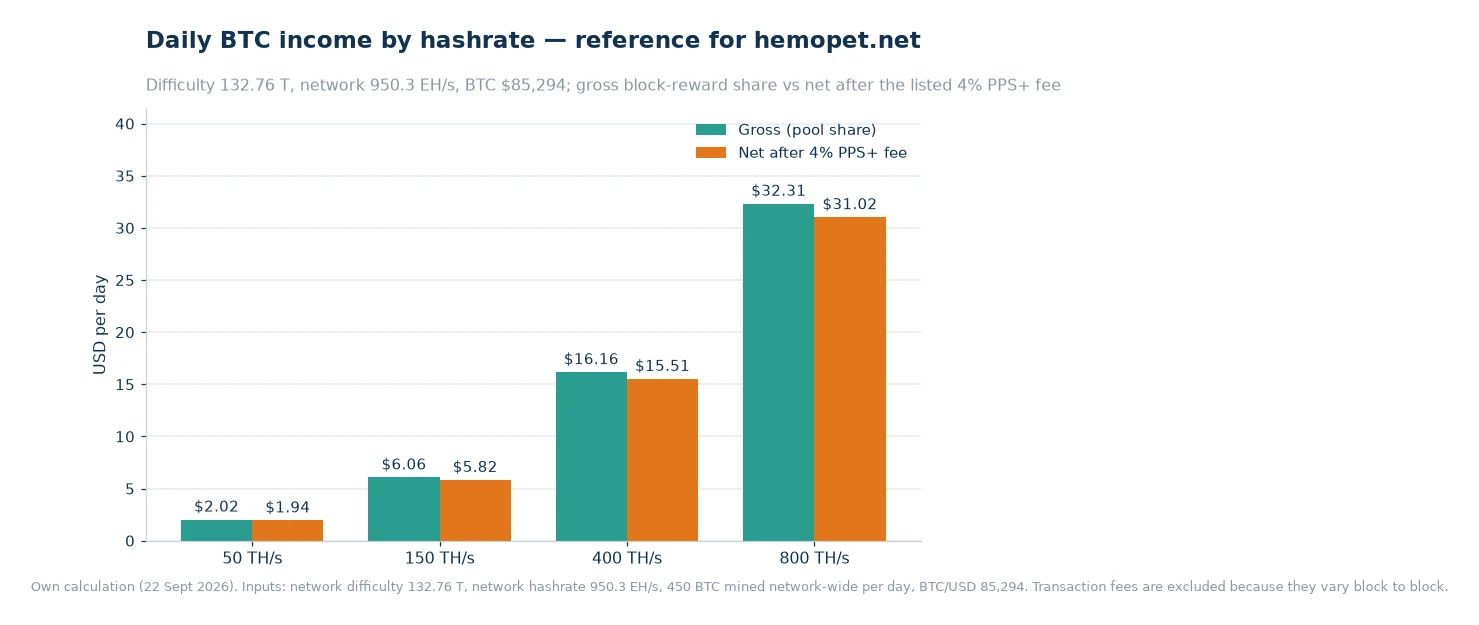
A purchase decision on mining hardware has two numbers in it: what the machine costs and what it earns per day. The second is published, the first is negotiated. At difficulty 132.76 T a 400 TH/s unit produces about $16.16 a day gross and $15.51 after the listed 4% fee, so a 0.01 BTC target at that hashrate takes roughly 53 days to mine. Everything else in the negotiation should be read against those two figures.
Key takeaways
- Benchmark every quote against daily output: $2.02 a day gross at 50 TH/s, $16.16 at 400 TH/s and $32.31 at 800 TH/s before the listed 4% fee.
- Days to mine 0.01 BTC run from about 422 days at 50 TH/s to 26 days at 800 TH/s — the clearest way to compare a small batch with a large one.
- Wall efficiency decides what a machine can tolerate: about $0.0841/kWh at 20 J/TH, or $0.1122/kWh at 15 J/TH.
- Confirm warranty transfer, batch and delivered condition, and whether Miner Hosting is bundled or priced separately.
What a listed supplier is being asked to prove
A directory entry tells you that a company exists, names the service it offers and provides a channel to contact it. That is a start, not a due diligence file. The useful part of a listing is that it lets several suppliers answer identical questions: which model and which production batch, what the delivered condition is, whether the firmware is stock, how long the warranty runs and whether it transfers with the machine, and when units can actually ship.
Mining Companies that also host are worth a second conversation, because the supply decision and the hosting decision share the same variable. A machine with poor wall efficiency can look cheap per terahash and still lose money on a tariff a more efficient unit handles comfortably, which is why the power rate belongs in the purchase conversation rather than after it.
Efficiency is the specification that travels
Joules per terahash decides which sites a machine can survive. At 20 J/TH a unit consumes 0.48 kWh per TH/s a day, so the gross income of $0.0404 per TH/s per day covers a tariff of about $0.0841/kWh before the listed fee, or $0.0808/kWh after it. A 15 J/TH unit needs 0.36 kWh per TH/s a day and stays viable up to roughly $0.1122/kWh gross. The same megawatt hosts a materially different amount of hashrate depending on which of those two units you buy.
Ask for the figure measured at the wall, under the firmware that will ship, at the ambient temperature of the site where the machine will run. A datasheet efficiency taken in a cool test room and a delivered unit running in a warm hall are not the same number, and the gap lands on the power bill every day for years.
| Item to verify | Question to ask | Figure that tests the answer |
|---|---|---|
| Model and batch | Which production batch, and does batch affect efficiency? | Wall efficiency in J/TH, not datasheet efficiency |
| Delivered condition | New, refurbished, or used with a stated hash-board history? | Expected daily output versus $0.0404 per TH/s per day |
| Warranty | Duration, transferability, who pays shipping on a claim? | Repair turnaround days versus $15.51 a day of idle income at 400 TH/s |
| Power tolerance | What tariff does this unit stay profitable at? | About $0.0841/kWh at 20 J/TH, $0.1122/kWh at 15 J/TH |
| Deployment | Is Miner Hosting bundled, and at what rate per kWh? | Daily power cost against daily net income |
| Delivery | Dispatch date, freight, duty, who insures the shipment? | Days of forgone output during the wait |
Worked example: 0.01 BTC at three batch sizes
Take a target of 0.01 BTC, which is about $852.94 at a price of $85,294. At 50 TH/s the daily output is 0.00002368 BTC, so the target takes roughly 422 days. At 400 TH/s the daily figure is 0.00018941 BTC and the same target takes about 53 days. At 800 TH/s it takes about 26 days.
Now add the fee and the power. The 50 TH/s unit earns $2.02 a day gross and $1.94 net of the listed 4% charge on the block-reward component; at 20 J/TH it draws 24 kWh a day, which costs $1.44 at $0.06/kWh, leaving about $0.50 a day. The 400 TH/s unit earns $15.51 net and pays $11.52 for 192 kWh, leaving about $3.99 a day. The 800 TH/s unit nets $31.02 and pays $23.04 for 384 kWh, leaving about $7.98 a day — sixteen times the margin of the smallest batch from sixteen times the hashrate, because fixed overheads sit outside this comparison and scale separately.
All three horizons assume today's difficulty holds. At the estimated 1.90% increase every daily figure eases by roughly that share and each target takes correspondingly longer to reach, which is why wall efficiency deserves more attention than a small difference in price per terahash.
Where the listing fits into the process
Use the listing to build a shortlist, then put the same six questions to every supplier on it and keep the answers in one table. That turns a market of scattered quotes into a comparison where price per terahash is weighed against wall efficiency, warranty terms and delivery date — the four variables that decide whether a machine is a good buy at a given site rather than in general.
Start from the ViaBTC Mining Companies directory, which covers suppliers and hosts in one place, and check the model you are considering against the Miner Profitability Ranking to see what it earns per day at today's price and difficulty. If the numbers survive that check, the next step is a hosting quote rather than another supplier.
Frequently asked questions
Is it better to buy from a large listed company?
Size helps with warranty handling and delivery reliability, but it does not change the arithmetic. Compare wall efficiency and daily output per unit whatever the company's size.
Should I buy new or refurbished machines?
Refurbished units can make sense if the hash-board history is disclosed and the price reflects the shorter remaining service life. Ask for the wall efficiency of the actual batch, not of the model.
How do I compare two machines with different hashrate?
Convert both to net dollars per day at current difficulty, then to days needed for a fixed BTC target. At 50 TH/s that is about 422 days for 0.01 BTC; at 400 TH/s it is about 53 days.
Does the payout method matter at purchase time?
It sets when the machine's output reaches you. PPS+ settles hourly at current difficulty, while PPLNS distributes after the pool's block receives six confirmations over the last five difficulty rounds.
Put the two numbers side by side before you order
Ask the supplier for a delivered price per terahash, then compute what that terahash earns per day at current difficulty after the listed fee and after the power tariff the machine will actually face. Divide the price by the daily margin and you have a payback horizon you can compare with the estimated 1.90% difficulty adjustment and with the machine's warranty length. If the horizon is longer than the warranty, buy the more efficient unit or negotiate the price — those are the only two levers the numbers leave you.
Data and sources: the ViaBTC directory of mining companies for suppliers and hosts[1], the profit ranking tool for per-model daily output[2] and the published fee schedule for the listed 4% PPS+ rate[3]. Difficulty of 132.76 T, a network hashrate near 950.3 EH/s, a 3.125 BTC block subsidy and a BTC price of $85,294 were the inputs, all read 22 Sept 2026. Power costs are illustrative examples, and no outcome is promised.