
Two Home Fragrance Quotes, 30% Apart: How to Decide
Two home fragrance quotes for the same brief can differ by a third without either supplier being dishonest. The gap usually sits in scope, in what happens after the filling line, and in the size of run being priced. Comparing the two totals is the least informative thing a buyer can do, because it compares two different projects. Work through the lines that generate the difference, decide which version of the project you are actually buying, and the choice becomes a matter of fit rather than of arithmetic.
Key takeaways
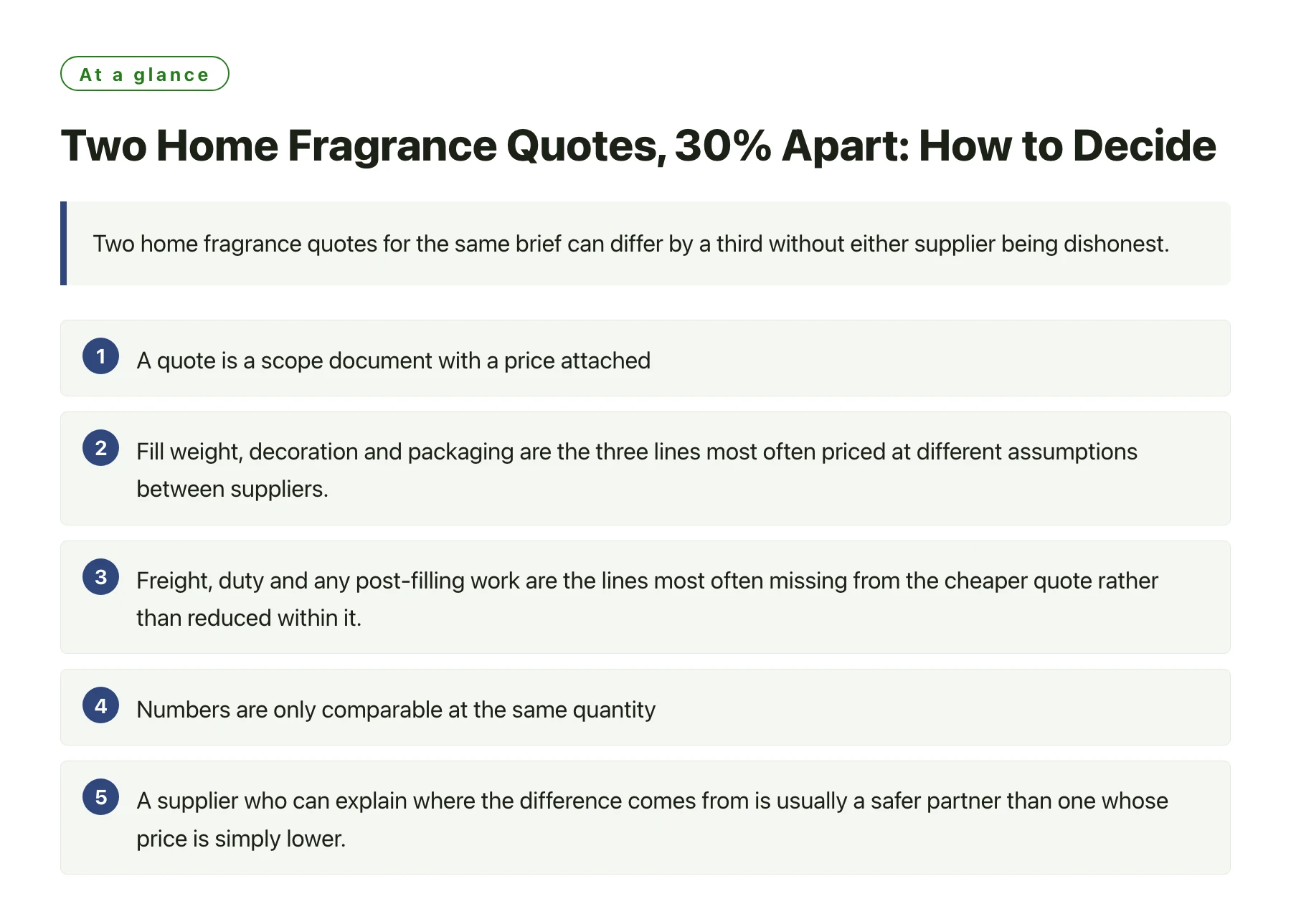
- A quote is a scope document with a price attached; when two quotes differ, the scope usually differs first.
- Fill weight, decoration and packaging are the three lines most often priced at different assumptions between suppliers.
- Freight, duty and any post-filling work are the lines most often missing from the cheaper quote rather than reduced within it.
- Numbers are only comparable at the same quantity, the same packaging specification and the same delivery term.
- A supplier who can explain where the difference comes from is usually a safer partner than one whose price is simply lower.
Procurement work in home fragrance has a familiar moment: three quotes arrive, two of them sit close together, and one is noticeably lower. The instinct is to treat the lower number as the market rate and the others as padding, or the reverse. Neither reading survives contact with the detail.
This is written from the buyer's seat, for the point where the quotes are open and the decision has to be explained to a founder or a finance colleague. The method below is deliberately short, because the aim is not to run an audit of every supplier but to decide which quote describes the project you are running.
The gap is rarely about the unit price
A unit price is a quotient. It depends on the quantity in the run, the packaging specification, the fragrance dosage, the fill weight and the delivery term. Move any one of those and the quotient moves, which is why two suppliers can both be quoting honestly and still differ by a wide margin.
The practical consequence is that the cheapest quote is often the one with the narrowest definition of the job. That is not automatically wrong; a supplier who prices only compounding and filling is being accurate about what they do. It becomes a problem when the buyer reads the number as an all-in cost and plans the launch budget around it.
It also helps to know what kind of party is quoting. A quote from a private label partner for perfume lines and a quote from a specialist compounder are answering different questions, which is usually the whole explanation for the distance between their totals.
Normalise before you compare
Rewrite each quote against one shared scope: the same fragrance dosage, the same fill weight, the same vessel, the same carton, the same quantity and the same delivery term. Where a supplier has not priced a line, mark it as unknown rather than as zero. A trail of unknowns is the clearest explanation of a 30% gap, and it takes an hour to assemble.
Ask what the price excludes
The shortest route to understanding a quote is to ask for the exclusions in writing. Suppliers who know their own boundary will answer in a paragraph. Suppliers who have not thought about it will answer with a promise, and a promise is not a scope.
Packaging scope is moving, not standing still
Packaging work is one of the lines where scope quietly differs, and it is also a line under external pressure. Rules in the European Union are tightening around packaging recyclability and packaging reduction, which is why some buyers price packaging work into the first scope instead of treating it as a later improvement [1]. A supplier who can say how a vessel or carton choice will look under those rules is answering a question the cheaper quote has not yet asked.
Where the difference usually sits
| Quote line | What it can absorb | The question that resolves it | What a good answer sounds like |
|---|---|---|---|
| Fragrance dosage | A lighter load at the same scent name | What dosage in percent is priced, and what was sampled at? | A number that matches the approved sample, with a version |
| Fill weight and vessel | A smaller fill or a lighter vessel at the same shelf height | What fill weight and which vessel grade are priced? | A specification, not a category description |
| Decoration and labelling | Fewer colours, no foiling, or artwork supplied by the buyer | Which decoration steps are included, and who prepares the artwork? | A step list with the party responsible for each |
| Testing and documentation | Compatibility, stability and labelling groundwork omitted | Which tests are included before the first shipment? | Named tests with a stated pass criterion |
| Freight, duty and delivery term | Ex-works price compared against a delivered price | Which Incoterm applies, and what is excluded at destination? | A named term with the boundary stated |
The last row explains more quote gaps than the first four combined, because an ex-works figure and a delivered figure are different products. Fix the term first, then compare everything else.
A decision order that avoids renegotiation
- Fix the quantityCompare at the run size you will actually order, not at the size that produces the nicest number. Volume changes unit cost in every category.
- Fix the packaging specificationVessel, closure, decoration and carton. Two quotes cannot be compared while one of them is pricing a lighter jar.
- Fix the delivery termChoose the Incoterm before you look at totals, and convert both quotes to the same term if you can.
- Mark the unknownsList every line only one supplier has priced. Those lines are the gap, and they are also your negotiation list.
- Decide what the launch must proveIf the first order exists to test demand, a narrower scope is rational. If it exists to establish a shelf presence, the narrower scope usually is not.
Putting the two quotes on one page
Rewrite both quotes onto a single sheet with the same lines: dosage, fill weight, decoration, testing, delivery term and quantity. Any line that only one supplier has priced stays visible as an unknown rather than as a zero. When the sheet is finished, the gap usually resolves into two or three lines, and those are the only lines the meeting needs to discuss.
This is also the moment to read the underlying reasoning rather than the totals. Buyers who want a worked view of comparing fragrance manufacturing quotes should start from the same open-book position with every supplier, because a supplier who explains a line is easier to check than one who only defends a number.
When the cheaper quote is the right one
A narrower quote is often correct. A brand testing a single scent in one market may genuinely not need a custom vessel or an extended testing programme on the first run, and paying for both would slow the decision the first order is meant to inform. The mistake is not the choice; it is making that choice accidentally.
Two pieces of evidence make the choice safer. The first is a written scope, because it converts the price into something that can be compared and later audited. The second is a named testing plan, because compatibility with wax or with a diffuser base is exactly the kind of question a thin quote leaves unanswered until the batch exists [2]. A supplier who is comfortable describing what they do not cover, and who presents the programme as choosing a private label perfume partner rather than as a list of adjectives, is easier to hold to a standard.
Where the scent itself is the differentiator, a broader scope tends to pay for itself, because reformulation and re-testing later cost more than doing the work once. Where the product competes on price, the narrower route can be the whole strategy, provided everyone has agreed which one you are running.
A practical rule for quote reviews: never present a single total to your own board. Present the normalised scope, the excluded lines and the delivery term. A total without those three is not a cost; it is a number that will change.
Sources
- European Commission: Packaging Waste and the PPWR —— EU rules on packaging and packaging waste, including the Packaging and Packaging Waste Regulation requirements on recyclability and design.
- SGS: Cosmetics, Personal Care & Household Testing —— Testing, inspection and certification services for cosmetics and personal care, including microbiological, stability and safety testing aligned with cosmetics GMP.
Frequently asked questions
Why are home fragrance quotes so different for the same brief?
Because the brief is rarely the same. Quantity, fill weight, vessel, decoration, dosage, testing and delivery term all move the price, and suppliers quote the version of the job they believe they were asked to do.
Should I always choose the lowest quote?
Choose the lowest quote for the scope you actually need. If a cheaper quote excludes work you will have to buy elsewhere, add that cost before comparing, and compare against the same delivery term.
What is the fastest way to compare quotes from different countries?
Convert everything to one currency and one delivery term, then compare line by line. Freight, duty and clearing are where cross-border quotes usually diverge, not the manufacturing cost.
How many quotes should a first home fragrance order collect?
Three is usually enough to establish a range and to see which suppliers answer questions in detail. Beyond that the returns fall quickly, because most of the difference is scope rather than rate.
Can I ask a supplier to match another quote?
You can, but ask them to match the scope rather than the number. A matched number against a different scope simply moves the gap to a later invoice.