
Chained Payments: Clearing a Stuck Transaction When Inputs Are Unconfirmed
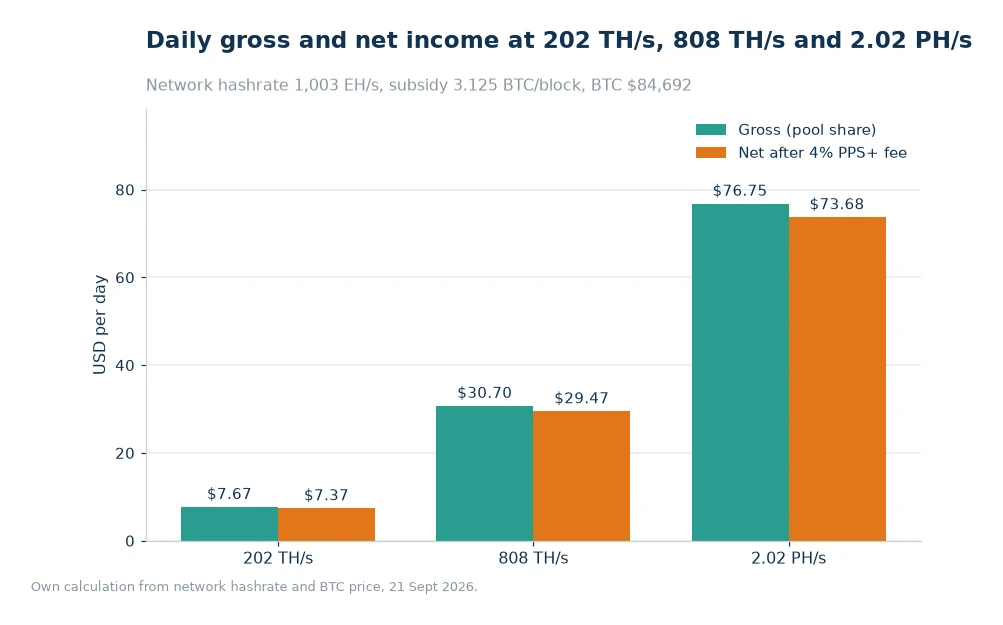
The awkward case in transaction acceleration is not a low fee; it is a payment built on coins that have not confirmed yet. The accelerator refuses to build on an unconfirmed parent, so the fix is sequential rather than simultaneous. The value at stake is easy to size: at 202 TH/s a day of mining is 9.062e-05 BTC, $7.67 at $84,692 per BTC and $7.37 after the listed 4% on the block-reward component.

Key takeaways
- 202 TH/s produces 9.062e-05 BTC a day, $7.67 gross and $7.37 net, which is the cost of one day's delay on a payout of that size.
- A transaction whose input is unconfirmed cannot be accelerated; the parent must confirm first.
- Free submissions require 0.5 KB or less and a fee rate of at least 0.0001 BTC/KB, inside an hourly quota.
- Double-spend attempts are rejected, and a paid submission is final: no cancellation and no refund.
The parent always goes first
A wallet balance is a set of outputs, and a new payment spends one of them. If the output being spent came from a transaction that is still unconfirmed, the new payment is a child of an unconfirmed parent, and it cannot be mined before its parent. Every pool enforces that ordering, so an accelerator that accepted the child would be promising something the chain cannot deliver.
This is why the rejection message matters more than it seems. The transaction is not invalid, and the fee is not necessarily too low. It is simply waiting on another transaction, and the only route forward is to get the parent confirmed. Submit the parent, wait for it to confirm, then submit the child.
How the queue behaves
The free route runs on an hourly quota allocated first-in, first-served. A submission that arrives after the quota is used waits for the next hour, which means the practical advice is to submit early rather than to submit repeatedly. Multiple submissions of the same transaction do not create additional queue positions.
Inclusion happens in the next block the pool mines. That is a claim about one block producer rather than about the network as a whole, which is why the service is run by a pool instead of a wallet. The pool controls what goes into its own blocks; it does not control what other miners include.
When paying is the cheaper option
The paid route exists for transactions that do not meet the free thresholds or that arrive after the quota. Payment can be made in BTC, BCH or LTC and is deducted from the account balance. The decision is a straight comparison: the fee against the cost of the delay.
Put a number on the delay using the mining side, because that is the number an operator actually knows. A day of output at a given hashrate is a concrete amount, and if a payment is a settlement that would otherwise sit for three days, the value of clearing it early is three days of whatever that money would have done. For a $7.37 payout the answer is usually to wait; for a payroll or a supplier invoice the answer is usually to pay.
What one day of output is worth
The bands below convert hashrate into the value of a single day's coins, which is the unit the delay calculation needs. The inputs are 1,003 EH/s of network hashrate, 3.125 BTC per block over 144 blocks, and $84,692 per BTC.
| Hashrate | BTC per day | Gross per day | Net per day | Three days of delay |
|---|---|---|---|---|
| 202 TH/s | 0.00009062 | $7.67 | $7.37 | $22.11 |
| 808 TH/s | 0.00036251 | $30.70 | $29.47 | $88.41 |
| 2.02 PH/s | 0.00090618 | $76.75 | $73.68 | $221.04 |
Those figures are the reason the paid route is not automatically the wrong choice. Three days of delay on a 2.02 PH/s payout ties up $221.04 of value, and a paid acceleration priced well below that is a sensible purchase. At 202 TH/s the same three days tie up $22.11, which most paid fees would exceed.
Worked example
Start from the daily output, then build the delay comparison for a chained pair of transactions.
- Network share: 202 divided by 1,003,000,000 TH/s equals 2.014e-07.
- Daily coins: 2.014e-07 multiplied by 450 BTC equals 9.062e-05 BTC.
- Gross value: 9.062e-05 multiplied by $84,692 equals $7.67.
- Listed fee: 4% of $7.67 is $0.31, leaving $7.37 net.
- Four times the hash at 808 TH/s: 0.00036251 BTC, $30.70 gross, $29.47 net.
- Ten times the hash at 2.02 PH/s: 0.00090618 BTC, $76.75 gross, $3.07 of listed fee, $73.68 net.
- Three-day delay at 2.02 PH/s: $73.68 multiplied by 3 equals $221.04 tied up in the wait.
- Now the child transaction: it cannot be accelerated until its parent confirms, so the cost of the two-step fix includes the parent's wait plus the child's block, and only the second step is within the accelerator's control.
A four-question decision rule
First: is the transaction still unconfirmed, and does it have unconfirmed inputs? If yes, the parent is the job. Second: what are its size and fee rate, measured rather than estimated? A transaction at 0.5 KB or less paying at least 0.0001 BTC/KB has a free route. Third: what does a day of delay cost in the currency you actually use? Fourth: does the paid fee fit comfortably below that cost?
Answering in that order avoids the two common mistakes: submitting a child that cannot be mined, and paying to accelerate a transfer worth less than the fee. Neither mistake is expensive once, and both become expensive as a habit.
Keep the transaction record close to the wallet that made it. A multi-currency wallet with one history makes it obvious which output a payment spent, which is the information the parent question depends on. Reconstructing that from three separate explorers is how an afternoon disappears.
The rest of the chain still needs managing
Acceleration clears a specific transaction, not a backlog. If several payments are queued behind one another, work through them in order of dependency rather than in order of importance, and accept that the chain clears at the speed of its slowest link. For a miner receiving frequent payouts, the simpler discipline is to spend from confirmed balances and treat acceleration as an exception rather than a routine.
The ViaBTC TX Accelerator is built for that exception, with a free tier for small, reasonably priced transactions and a paid tier for everything else. Knowing which tier applies before a payment gets stuck is the difference between a five-minute fix and a day of watching a mempool.
Frequently asked questions
Why can a transaction with unconfirmed inputs not be accelerated?
Because it cannot be mined before the transaction that created its input. The accelerator handles that dependency by rejecting the child until the parent confirms.
Does submitting the same transaction twice help?
No. The free queue is first-in, first-served and duplicate submissions do not create extra positions, so submitting early in the hour is the useful move.
Is a paid acceleration ever the cheaper choice?
Yes, when the delay it removes is worth more than the fee. Three days of output at 2.02 PH/s is about $221.04, against $22.11 at 202 TH/s.
Sequence before you submit
Check the input status, measure the size and fee rate, and price the delay in the currency you actually spend. Then submit once, early in the hour, and leave the parent-child order intact. That sequence resolves most stuck payments without a paid fee and keeps the paid route for the cases that justify it.
Sources: the accelerator's published eligibility and submission rules[1], with chain inputs read 21 Sept 2026: network hashrate about 1,003 EH/s, difficulty 132.76 T, subsidy 3.125 BTC per block over 144 blocks a day and BTC at $84,692. Figures read 21 Sept 2026, published 22 Oct 2026.